Lot Details
Description
Francesco Paglia attr.
Saint Catherine of Siena
Olio on canvas
in 28,15x35,24
The central figure is Saint Catherine of Siena, recognizable through various traditional iconographic elements. Her youthful and gentle face bears an ecstatic and contemplative expression, typical of depictions of mystical saints. She wears a golden crown, symbolizing her spiritual royalty and her importance within the Church (she is a Doctor of the Church and patron saint of Italy). A white veil covers her hair, characteristic of the Dominican habit, the order to which she belonged as a tertiary. In her right hand, she holds a martyr’s palm and a crucifix, symbols of faith and deep mystical devotion. The palm, in particular, also represents spiritual victory and sacrifice.
The setting is sober, with a dark and undefined background that emphasizes the figure of the saint within a painted oval, giving the impression of a framed portrait. This is a mature work, likely dating to the late period of Francesco Paglia’s painting career (Brescia, 1635–1714), as suggested by clear stylistic references found in similar works in the city of Brescia. These include the cycle of roundels depicting saints painted at the end of the century for the Basilica of Madonna delle Grazie, and a Saint Eurosia housed in the Diocesan Seminary. Several stylistic features are typical of Paglia: for this Saint, whose resemblance to the Seminary painting is striking, the diagonal composition stands out as a figurative prototype frequently used by the painter. Also characteristic is the flattened background, clearly intended to highlight the narrative subjects, enhanced by the subtle use of diffused light and veiled color.
From the critical analysis, Dott. Michele Peli
The painting is accompanied by:
Expertise Dott. Michele Peli
Dimensions
in 28,15x35,24
Provenance
Private collection
Conditions
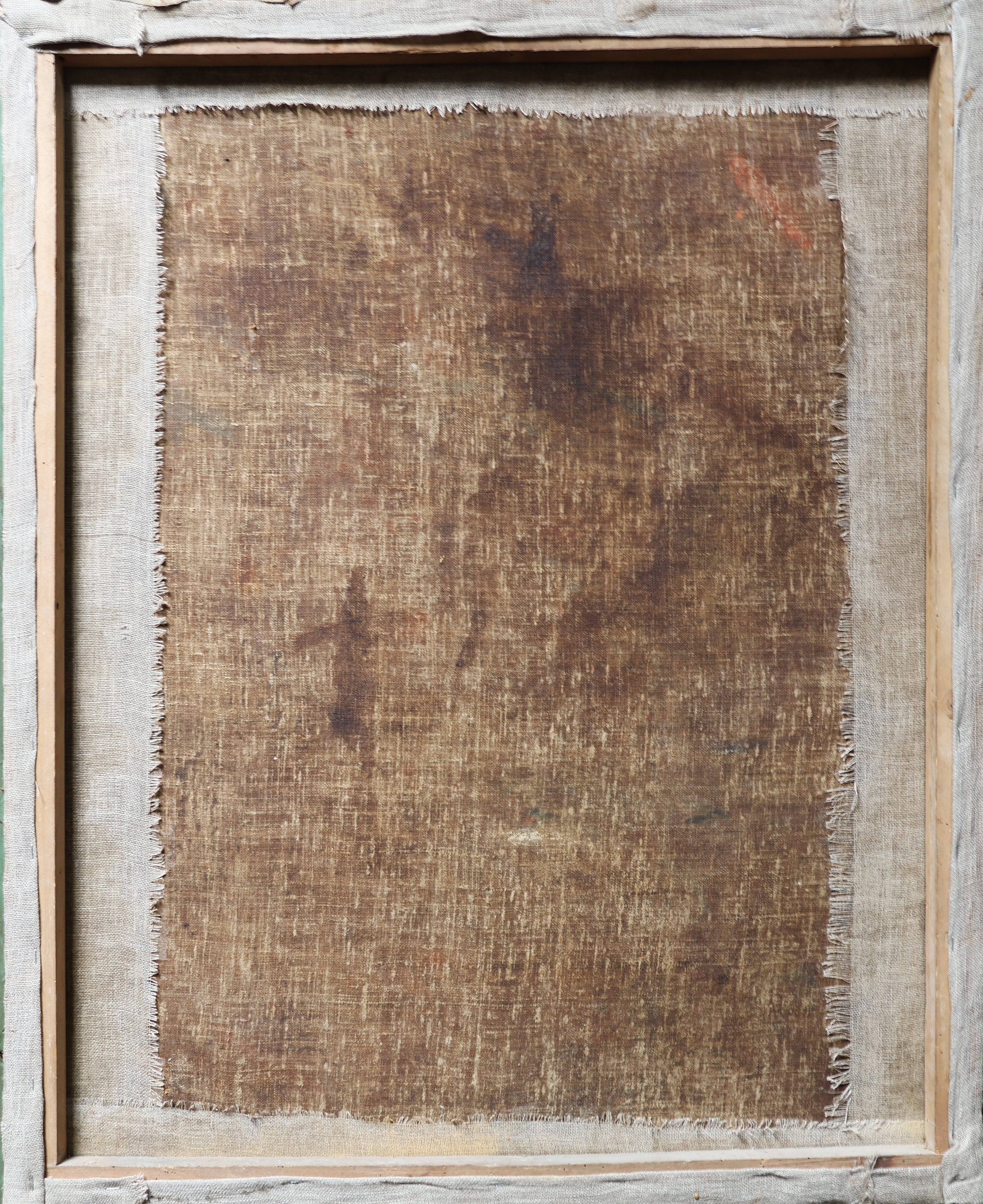
The painting, on its original canvas, has recently undergone conservation restoration. There are slight traces of retouching from earlier restorations.
Since we are not professional conservators or restorers, we urge you to consult with a restorer or conservator of your choice who will be better able to provide a detailed, professional report. Prospective buyers should inspect each product to satisfy themselves as to condition and must understand that any statement made by Coradi Rare Finds is merely a subjective opinion.